fernet branca: the pipe cleaner

sink drain

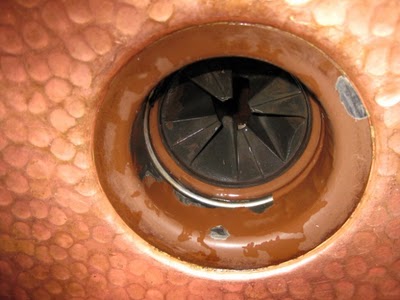
I know what you're thinking, but it's just a sink drain.

A FEW DAYS AGO, I noticed a foul odor in my kitchen. My first thought was that it was emanating from the refrigerator, from one of my partner Leah’s lacto-fermentation projects, which can thrive happily and stink up the fridge for months. But when I washed my hands in the kitchen sink, a dead cabbage smell wafted up to my nose, and I realized that something was rotting in the drain.

I hoped the stank in the sink would be easy to extinguish, but Leah’s efforts proved futile. Throughout the day, she poured various substances down the drain: boiling water, dish soap, baking soda, vinegar, bleach. As a last resort, she tossed in a splash of Fernet Branca. If that didn’t improve the bouquet, she said, then she’d take apart the pipes tomorrow.

Since I wrote about Fernet Branca in an earlier column, I’ve been surprised to find how many people enjoy drinking this medicinal, menthol liqueur; One friend fondly reminisced how his great-aunt used to give him a spoonful for tummy aches when he was a child, his introduction to the healing power of liquor. Many people were shocked to hear that I, a lover of all booze, was not in love with this particular amaro.

My distaste for Fernet Branca comes from a bias: I am not a fan of cooling herbs. Perhaps it’s from having Vicks VapoRub shoved up my nostrils on a tissue torpedo when I had a cold as a child. Or maybe I used too much Ben Gay on torn ligaments when I was a cheerleader, when the coach insisted we do full splits at tournaments even when our bodies insisted we couldn’t. (It’s true. I cheered, complete with feathered hair, fringy pom poms and a short-short black and gold skirt. You can stop laughing now). Mint ice cream and mint juleps are on my most-hated list. Even toothpaste challenges me. Right after I brush my teeth, I can’t drink a glass of water without gagging. The only exception to my mint aversion is mojitos, which I can easily consume in large amounts. The muddled limes seem to castrate the mint and leave it powerless to offend me.

Which got me thinking: Maybe I’d be able to tolerate Fernet Branca in a cocktail with lime.

When I mentioned this idea to Leah, she suggested I start with a base alcohol that could compete with the menthol, like a peaty scotch. For this drink, I chose cognac. I added lime juice and sugar, and topped it with a splash of club soda, because, gosh darn it, bubbles are fun, and the Fernet needed something on its side.

The resulting cocktail was palatable and refreshing. The lime did the trick, and I felt relieved to tell my friends that I, too, had found a way to appreciate the highly regarded Fernet Branca. I don’t love it, but like any alcohol, it’s all in how you mix it.

And miraculously, when mixed with boiling water, dish soap, baking soda, vinegar, and bleach, Fernet Branca cured the drain of its malodorous ailment.

Pipe Cleaner

1 ½ ounces cognac

¼ ounce Fernet Branca

¼ ounce lime juice

1 teaspoon sugar

club soda

lime wheel

Fill a shaker with ice. Add cognac, Fernet Branca, lime juice and sugar. Shake. Strain into a double rocks glass filled with ice. Top with club soda. Garnish with a lime wheel.

-Amelia Sauter

tastes like the finger lakes

the still

Homemade hooch in my backyard

EVERY TIME I visit Finger Lakes Distilling in Burdett, New York, I find master distiller Thomas McKenzie hard at work downstairs. Today, in the shadow of the towering, twenty-foot tall copper still and surrounded by dozens of barrels that line the walls, Thomas is coercing the juice from blueberries with a hand-cranked wooden barrel press. His hands are stained a murderous blood red, and indigo streaks mark his face and shirt. He spies the photographer with me. “Don’t shoot my britches,” says Thomas with a southern accent that curls like molasses, “cuz I got blueberry juice all over ‘em.”

The air in the building is heavy with the lingering scent of fermenting corn mash. The pervasive, permeating presence of the aroma is much like a grandmother’s house that has a distinctive, comforting smell even when nothing is in the oven. I’m particularly excited about my visit today; I don’t know if Thomas and president Brian McKenzie (who has the same last name as Thomas, but is no relation) will agree, but for me their announcement this week is one of the most exciting since I first heard the rumors of the opening last July: They finally have a date for their bourbon release.

Finger Lakes Distilling renders me giddy. It’s not just the excellent liquor, made with local berries, corn and grapes. It’s the idea of a distillery in my own neighborhood. Though they are legally producing liquor, the thought of a still near the edge of the Hector National Forest feels thrilling and naughty, like smoking in the girls’ bathroom or, I imagine, growing marijuana hidden between tomato plants in your garden.

Though Finger Lakes Distilling is a classy venture, with architecture and tasting room décor inspired by the distilleries of Scotland, I can’t stop myself from calling their product “hooch.” Their business is the first of its kind in the Finger Lakes region to focus solely on liquor. Recently relaxed restrictions on farm distilleries, which allow farms to have tasting rooms, combined with the rising popularity of craft spirits have led to a growing trend in New York State: this summer, three more distilleries are slated to open in Brooklyn alone.

As the story goes, Thomas and Brian met three years ago at a distilling conference in Louisville, Kentucky. Thomas comes from a long line of distillers, but he’s the first to legally take on the task. His thick Alabama accent conjures up visions of a dilapidated backyard shed that houses a ramshackle still. You can almost taste Thomas’ family heritage in all of the liquors here, brought to life by Brian’s entrepreneurial energy.

Initially, the distillery released vodka and gin, both made from local grapes, and both of which won Best in Class at the 2009 New York Spirits Awards. The gin, which boasts complex anise and citrus notes, has been a big hit with the public. The wild berry vodka is a perfect addition to a glass of lemonade. They produced sweet liqueurs next (I recommend cassis and raspberry), followed by rye and then grappa. Most recently, the distillery released an exquisite cherry liqueur that tastes like the juice of fresh-picked sour cherries. In my house, we went through three bottles in two weeks (for educational purposes, honest), and I’ll be taking another half case home with me today.

What I’ve been waiting for, though, is Finger Lakes Distilling’s bourbon. Like Thomas, I, too, have a history in the world of booze:  I come from a long line of devoted whiskey-drinkers. My partner Leah and I have followed the progress of the bourbon with regular visits to the Distillery, as it aged in new charred oak barrels and then moved to second-hand chardonnay barrels from Lamoreaux Landing Wine Cellars. Our faithful visits have been rewarded with sneak-peek tastings, or perhaps I should call them teasings, since they have only served to feed our impatience. When we had our first nip eighteen months ago, the bourbon was so brilliant, smooth and rich that I asked then why they were waiting to release it. “It needs to a-yage,” Thomas answered in his drawl, speaking the word “age” with two syllables. “It’s gonna get even better.”

And it most certainly has. Sitting with Brian and Thomas on barrels that house aging spirits, I get to taste the bourbon a few weeks before its release. It’s more mellow now, rounded, with hints of butterscotch, toasted caramel and rye. This bottle will easily sit on the top shelf with Booker’s and Basil Hayden. I ask Thomas how he would describe it. “It tastes like bourbon,” he says and we all laugh. Then he elaborates. “It tastes like old-time bourbon.”

Thomas explains that in the last fifteen or twenty years, liquor has typically been distilled and aged at higher proofs than it was previously, which allowed producers to fit more in a barrel, in turn reducing storage costs. Instead of aging their bourbon at 115 or 120 proof, Finger Lakes Distilling chose to age it at 100 proof. Brian believes the way the spirit interacts with the wooden barrels is affected by the lower proof, thus resulting in a different flavor.

Thomas disappears for a minute and comes back with a tiny bottle. “Try this,” he says, pouring me a splash of the brown liquor. It tastes amazing, different than any whiskey I’ve had before, though I lack the words to describe how. “Wild Turkey,” he says. “Distilled in 1971, bottled in 1978.” I wouldn’t turn twenty-one for another thirteen years.

Finger Lakes Distilling bourbon is made with 70% corn, 20% rye and 10% malted barley. The corn is not a hybrid, nor is it genetically modified. It is local, open-pollinated corn, and organic, too, which Brian says results in a superior fermentation. Less than 300 bottles will be available, and they suspect it will sell out quickly.

I pose one more question to the guys before I leave. What, I ask, is the essence that haunts every spirit from Finger Lakes Distilling, whether the grape-based vodka and gin, the corn liquor, the rye or the bourbon? It’s a mystery, they tell me. Brian thinks it may be a flavor imparted from their still. “Terroir,” says Thomas and I make him repeat it and spell it. A term frequently used in winemaking, terroir (pronounced te-wa) is loosely translated from French as “sense of place.”

“It’s the flavor of the land,” says Thomas. I agree. Tastes like the Finger Lakes to me.

On May 1, the Distillery will release the eagerly-awaited bourbon. A 750ml bottle will cost $45. Live music will be provided by Long John and the Tights in the afternoon, and you get a free tasting if you wear a derby hat. Those who arrive unadorned can pay $2 for a tasting, which is credited back if they make a purchase. And if that’s not enough to bring you out that day, Thomas adds, “You get to talk with me.”

The tasting room at Finger Lakes Distilling is open daily from 11 a.m. to 5 p.m. More information can be found at www.fingerlakesdistilling.com.

-Amelia Sauter
facelift

facelift

This will be me in forty years

ON THE EVE OF MY FORTIETH BIRTHDAY, I found myself in a Midwest hotel with a bottle of Hendrick’s gin. True, the hotel boasted a state-of-the-art fitness center, and my room had a fridge, but I was in the middle of Ohio, for chrissake, and furthermore I was in the company of a mob of conservative mini-van driving women with perfect hair, perfect makeup, and perfect wedding bands. It was the first time I celebrated a birthday alone, and I was surrounded by the type of women I always swore I’d never become.

Sitting on my king bed, I suspected I had made a mistake coming to this writers’ conference when I read the first line of the brochure: “Catholic in our faith, global in our mission.” My email in-bin provided a second unwelcome clue: my one-on-one session was scheduled with a man who worked for a publishing company that represented books with catchy titles like The Faithful and the Flawed, Your Phone Connection Vs. Your Prayer Connection, and The Trinity Diet. I cancelled my appointment. Someone overflowing with the holy spirit could have my spot.

At the registration table in the lobby, I was surrounded by what appeared to be suburban mommy bloggers and frumpy granny writers: the room overflowed with flat-ironed hair, penciled eyebrows and a disproportionate number of blondes. They all picked up their information packets and then sat down on the couches, meeting, greeting, chatting.  I hesitated. Should I join them, make some new friends? I thought perhaps I should hang out in the bar instead. Maybe I’d find the other degenerates in there, you know, the tattooed writers and socialists and gays with inappropriate senses of humor and foul mouths, the ones more than ready for a drink at two o’ clock on a Thursday afternoon. I changed my mind and hid in my room until dinner; if the bar ended up being full of drunken soccer moms, it could be a scary sight.

I used to insist I would age gracefully, that the phrase “plastic surgery” would never escape my lips, which would never be injected with collagen. During the height of my teenage soap opera addiction, I watched a character from The Young and the Restless, Katherine Chancellor, receive an on-air facelift. A written warning flashed across the screen, followed by scalpels, bloody flesh, heavy bandages and later, bruising. I was mortified that a beautiful woman would elect to have someone loosen the skin on her face with a knife and then yank it up like a pair of knee socks.

As I get older, procedures like laser skin resurfacing and facelifts no longer bring to my mind torture methods from old school horror movies. Rather, these treatments fall into the suspense or adventure comedy genre, like when I recently found myself engrossed in an older friend’s story about flying to Costa Rica for a bargain facelift. I was on the edge of my seat, asking, “And then what happened?”

“It was fabulous!” she raved, recounting her experience as more like a vacation than a major surgery, complete with handsome doctors with sexy accents, euphoria-inducing drugs and cocktails on the beach. All that was missing were the slides.

I didn’t meet any women at the conference who had facelifts, or if they did, we didn’t talk about it. But I did have more in common with the mommy bloggers than I imagined. We were all women with body issues, food issues and self esteem issues, trying to find balance in our lives, saving our money to buy the next anti-aging cream or an awesome pair of girly shoes, and escaping our day-to-days to immerse ourselves in something we each loved to do: write. We read each others’ humor blogs, giggled when the priest said grace before the meals (which was the only time God showed up) and saved each other seats at lunch like we were in high school.

One mother of two with a painted face, Jamie, advocated for me at the dinner table, helping me explain my innumerable food allergies to the catering manager (without apologizing nine times in one sentence). She was funny and supportive, and even took the stage during amateur comic night at the conference, an act of bravery that I deeply admired. Jamie said she refuses to leave her house without makeup, and I had a flash of judgment before I realized, wait a minute, I won’t leave my house without makeup, either! Another gal I met wrote for The Man Show on Comedy Central, every episode of which included girls with big boobs and bikinis bouncing up and down on a trampoline. That, I can definitely appreciate.

About to turn forty, and in a four-star hotel for four days with four hundred women, I celebrated my birthday by sharing a drink and laughter in the bar with my new friends, and I pondered whether my similarities to the other women outweighed the differences. I won’t pop out any kids, I can’t straighten my hair without resembling Gilda Radner, and since I haven’t had eyebrows my whole life, I don’t plan to start drawing them on now. However, I recently became a proud owner of Ellen DeGeneres-endorsed eye serum, and last year a dermatologist lasered some spots off my face. She did it for free the first time, because she knows those laser treatments are as addictive as crack. She stands to make a lot of money off my vanity.

And as for the facelift, I haven’t made up my mind yet. Ask me when I turn 50.

-Amelia Sauter

david sedaris in lil ol’ ithaca

Taughannock Falls

Apparently David Sedaris likes Ithaca.

DAVID SEDARIS IS ONE OF MY FAVORITE PEOPLE THAT I’LL NEVER MEET, second only to Hillary Clinton. Last night at the State Theater marked the first time I’ve seen him in person, and I was more than a little excited.

On Sedaris’ second day of a thirty-six day tour, the show appeared to be close to sold out. Security personnel hovered in every corner – in case someone rushed the stage for a hug? I’ve seen hug attacks happen before in seemingly civilized venues, once at an assembly at my all-girls Catholic high school when a pile of my peers tackled a morning show DJ who came to encourage our chocolate drive sales. You can never be too careful.

“No photographs,” the introducer announced, “and turn off your cell phones.” In response, I pulled my iPhone from my bag and snapped Sedaris’ picture. From the front row of the balcony, my view included the top of his balding head.

$44 per ticket was a lot of money to pay to hear an author read for an hour and a half. Dinner and drinks for two at the Trumansburg Pourhouse costs less, as does a day pass to the Grassroots Festival, and that buys you ten hours, multiple musicians, priceless face time and unbeatable people-watching opportunities.

What is it about Sedaris that leads us to hand over our money – and our hearts – to him? The universality of his topics combined with the ability to turn everyday occurrences into outlandishly funny moments results in stories that quickly draw in the audience. We envy his ability to say inappropriate things out loud that we would not dare whisper.

Two of his readings at the State were from his forthcoming “bestiary,” a collection of fables about animals, though as Sedaris put it, “Fables have morals.” He also shared excerpts from his diary and a piece on the angst of airline travel, where he translated stewardess-speak for the layperson, the underlying meaning of the request “Your trash?” being a judgment: “You’re trash.”

Sedaris’ appeal is as much about his presentation as about his writing. His dramatic pauses drive home punch lines. He knows this, and throughout the show, he jotted on his notes each time the audience laughed, which happened after almost every sentence. We laughed because we expected to laugh, because he’s David Sedaris. Even the things that weren’t really funny left us chuckling, like rats with pancreatic cancer or a dog who gets hungry when he smells burning flesh.

The woman seated beside us was infected with this anticipatory laughter, snorting uncontrollably throughout the reading, when Sedaris read benign sentences like, “He shakes the crumbs out of his mustache,” or “The bull terrier had creepy eyes.” If I wrote those lines, no one would laugh. Nor would they find it humorous if I said a woman left her teenage son in a burning house. Sedaris’ stories are as dark as they are comical.

But the main reason I think we all love Sedaris is that it feels he’s like one of us, but funnier, a regular curmudgeon who swears and complains a lot and checks his watch every ten minutes. During the question and answer period at the end of the show, when asked what animal he would cast himself as in a fable, he said a muppet, or a snail. To another question he quipped, “If I had a beach house, I’d name it Sea Section.”

We related even more when he said he visited one of our gorges. “If I were here longer, I’d go to…” Sedaris paused dramatically, and we waited, to hear his answer. Taughannock Falls? John Thomas Steakhouse? Rasa Spa? And he finished his sentence like a true local:  “…Pudgies and Cobblers Cottage,” he said. “These are prize winners.”

-Amelia Sauter

selective memories

Mr. Boston Bartenders Guide

1974 was a great year for cocktails.

“IS HISTORY IMPORTANT?” My preoccupation with this philosophical question started when a crazy ex-boyfriend hunted me down so we could “reconnect.” After I successfully avoided him for seven years, he cornered me in the periodical section of the public library, and yes, he actually cried. He argued in non-library tones that we should revisit our time together; our relationship the most beautiful year of his life, he said. Clearly, I thought, history is a construct, viewed through the biases of the reminiscer.

I politely declined his reconnection request. I’m not convinced that history is important, and my ex is a strong justification for never looking back. When I’m playing Trivial Pursuit, you won’t find a yellow pie wedge in my game piece. Geek though I am, history was my worst subject in school. In fifth grade, I failed my first test ever in world history. I bombed the American history AP exam in high school. I seem to be incapable of memorizing dates and historical events (though I remember in vivid detail Romeo’s naked buttocks in the 1968 film Romeo and Juliet, which we watched during tenth grade lit class).

My history angst stretches into the arena of cocktails. For the love of Dale*, I can never remember where classic drinks came from, who made them, and why. The elitist worship of old-school cocktails drives me crazy with its snobbery of “shoulds” and “shouldn’ts” that many bartenders try to impose on today’s drinks. I’m not interested in either shaking raw eggs into cocktails or glorifying the disgusting herbal liqueurs sold during Prohibition in pharmacies as “medicine.” Some cocktails are best forgotten, like my ex-boyfriend.

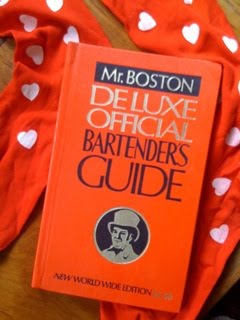
But family heritage is my notable exception. Be it stories or objects, I saved everything my parents ever gave me, like the pair of red knee socks with white hearts my mom bought for me twenty-five years ago. Though they’ve faded and the elastic is long-gone, causing them to bunch around my ankles and slide into my shoes, I still wear them every February 14th.

When Leah and I opened the Lounge, my parents passed on to us their 1974 Mr. Boston Bartenders Guide (53rd printing).  I flipped through the classics, but what caught my eye were the handwritten recipes penciled inside the back cover. Tequila sunrise. Daiquiri. In my dad’s script, Margaritas: Fill a blender halfway with tequila and the rest of the way with half triple sec and half either limeade or pop. And then there was my mother’s favorite drink, recorded in her slanty handwriting: Apricot Sour.  Reading the recipe, I could taste it in memory, its tart flavor known to me from eating the liquor-soaked maraschino cherry left at the bottom of her glass.

Apricot Sour

1 ½ ounce apricot brandy

1 ounce orange juice

¾ ounce lemon juice

a few drops of maraschino cherry juice

maraschino cherry

Fill a Collins glass with ice. Add brandy and juices. Stir. Garnish with maraschino cherry.

-Amelia Sauter

*Dale DeGroff, a master mixologist credited for the revival of classic cocktails.

fernet branca: the toronto

fernet branca

I can't decide if Fernet Branca is a liquor or a mouthwash.

FIRST, YOU NEED TO KNOW that Fernet Branca is one of the scariest liquids I’ve put in my mouth in a long, long time; second, that it is a liqueur highly regarded by the cocktail community.

I warned Leah,“Only buy one bottle,” but, ever-vigilant of quantity discounts, we’ve got three. Fernet Branca is an amaro, which doesn’t come from the Latin word for love, but rather is Italian for “bitter and tragically disgusting yet for some reason we are compelled to drink it.”

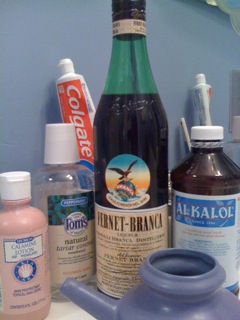
Describing Fernet Branca as medicinal and herbal with notes of eucalyptus and mint is a serious understatement; that would be like describing gasoline fumes as earthy and peppery. Think camphor meets green Nyquil. Or, have you ever used Alkalol? Alkalol is a “natural formula” brown menthol liquid that you snort into your sinuses, which both cleanses them of pollen and burns all the flesh off of your nasal passages. Alkalol and Fernet Branca: separated at birth?

If I haven’t scared you away yet, then on to the cocktails! With much trepidation, I poured our first drink: Fernet Branca and Coca-Cola, wildly popular in Argentina.

The responses from the elite panel of judges: Dad says it tastes like Vicks VapoRub meets birch beer. Leah says, “I wouldn’t dump it out,” but I notice she doesn’t drink any more of it, and later, she dumps it out. I like the bitter finish, but I simply can’t stomach the menthol edge.

Take two. I mix Fernet Branca with something bolder than Coke: Finger Lakes Distilling’s McKenzie rye whiskey. The resulting drink, the Toronto, is a classic reminiscent of an Old Fashioned, but with an invigorating smack in the nostrils and a bitter finish. The three of us agree we can almost appreciate this cocktail.

Supposedly, Fernet Branca is an acquired taste that develops only with regular drinking. Stay tuned: We’ll revisit this one in a second column and see if the Fernet Branca lands on the bar beside the Campari, or on the bathroom counter next to the neti pot.

The Toronto

2 oz Finger Lakes Distilling McKenzie rye whiskey
¼ ounce Fernet Branca
¼ ounce simple syrup
twist of orange peel

Pour all ingredients over ice. Stir for twenty seconds. Garnish with a twist of orange peel.

-Amelia Sauter

progressive destruction disorder

getouttabedaphobia

I'm crazy, you're crazy, we're all crazy.

WHEN YOU STUDY THE DSM-IV (which will soon be the DSM-V), you suddenly discover every single one of your friends and family members has a serious mental illness. You read it, therefore you diagnose it, as matter-of-factly as you wake up, therefore you get out of bed. The Diagnostic and Statistical Manual of Mental Disorders, Fourth Edition, is the current psychotherapist’s bible. It describes in painstaking detail every psychological disorder officially recognized by an elite team of mental health professionals.

I’ve heard the same phenomenon seizes wanna-be doctors when they attend medical school. They get a bellyache and wonder, Do I have appendicitis? Diverticulitis? Abdominal cutaneous nerve entrapment syndrome?

For those studying abnormal psychology, the diagnosing starts with ex-boyfriends, loved ones and pets. Your mother-in-law is histrionic. Your sister has obsessive-compulsive tendencies. The cat has panic attacks. Your ex-boyfriend is an asshole – oh, wait, that’s not a diagnosis – your ex-boyfriend has narcissistic personality disorder. The realization that everyone in the whole world is certifiably crazy soon extends to people you’ve never met, like the child throwing a tantrum in the grocery store who obviously has oppositional defiant disorder, sure to blossom into conduct disorder since his mother appears to be bipolar.

At three o’clock in the morning, when your partner is fast asleep beside you, and you are mid-way through reading the DSM-IV, all eight hundred eighty-six pages that your professor has insisted you memorize from beginning to end, you realize that you have the symptoms of two-thirds of the two hundred ninety-seven mental illnesses in the book. You, too, are diagnosably crazy, nuts, cuckoo, bonkers, wacko.

Panicked, you shake your partner awake. “I think I might be autistic,” you whisper. “Shut up,” she mumbles.

Now you can’t fall back to sleep until you’ve pinned it down. You have been feeling a little insane lately. You find yourself reading the DSM-IV late into the night like a cheap romance novel, scanning for the exciting parts, the detailed descriptions of dirty little secrets. Do you have Generalized Anxiety Disorder (300.02)? Adjustment Disorder with Mixed Disturbance of Emotions and Conduct (309.4)? Rumination Disorder (307.53)? Borderline Personality Disorder (301.83)?

While I was studying the DSM-IV, I arrived home one day to find my partner in the bedroom. The sheets lay in a heap on the floor, the mattress leaned up against the wall, and she had disassembled the bed frame into now unrecognizable chunks of pine that were once legs and slats and a headboard. This deconstruction of critical household objects happened frequently while I was out. My partner would tear apart a piece of furniture she had built or knock a hole in the wall, because she had a vision in her head of something better, stronger, more amazing. She was either schizophrenic, or she had an artist’s brain. I hoped it was the latter.

“Hey!” I shouted as she hammered and banged amidst a pile of debris. “Maybe you’ve got progressive destructive disorder!”

She looked up at me. “What’s that?” she asked.

“It’s when you build something new, and you’re pleased with yourself for about ten seconds and then you get disgusted because you realize you can do better, so you rip it all apart and start over again. You feel your creations are never good enough, so you have to constantly destroy and rebuild them.”

“Oh my god, that’s me!” she said. “There’s a name for what I have. I feel so relieved I’m not alone.”

“Actually, I just made it up,” I said, laughing. I stopped laughing when her face fell.

She glared at me. “For a split second, I felt understood,” she said. She turned back to the bed-to-be, and I grabbed my DSM-IV to look up the diagnosis for someone who derives great pleasure from picking on a loved one.

-Amelia Sauter

rejected

rejection letter

Look familiar?

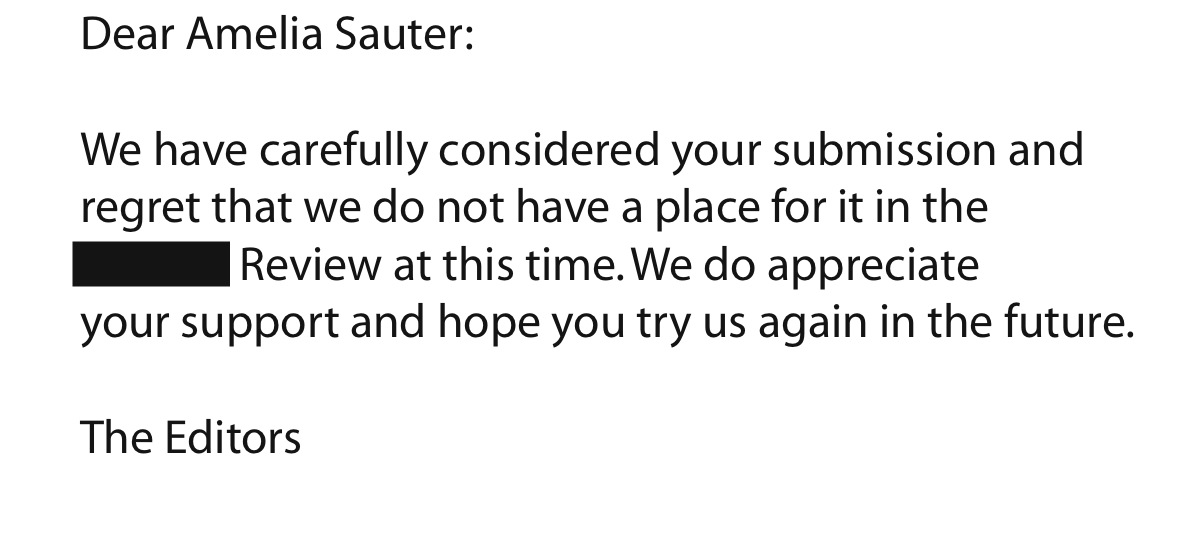
WRITERS GET REJECTED SOMETIMES. A LOT. Fact. The rejection letter in the image showed up in my email bin a mere four hours after I submitted a work of fiction online to a respected literary magazine. I had been working on the piece for over a year.

This generic letter reminds me of another letter that Leah and I received after we spent the night in Virginia at a Super 8 that must have just finished starring in a horror film. At 2am, after driving for six hours, we drove for two more hours in a torrential downpour and never-ending thunderstorm to find a hotel.  Everyone was booked due to the “model train show.”  Toot.

We finally pulled into a the parking lot of a Super 8 with a vacancy sign, right next to the drug dealer selling crack on the corner. The man behind the bullet proof glass asked us how many hours we wanted the room for. Bad sign.

Worse sign:  Once inside, Eesah refused to lay down. He paced the room over and over, past its dirt-streaked walls and torn off outlet covers. He’s a dog. He eats poop and rolls in dirt, but he refused to settle anywhere in the room.

When Leah pulled back the bedclothes, we gasped in unison. The underside of the comforter was stained with blood. That did it. We threw open the door. Add lightning strike and crash of thunder here.  It was raining so heavily we couldn’t even see the lobby.

Exhaustion took over. We threw our sleeping bags on top of the bed and let the dog join us there.  When we got home, I called 1-800-Super-8 and complained.  A few weeks later we got a letter in the mail from the Virginia Super 8:

Dear Amelia Sauter:

Thank you for your feedback on your recent stay at the Super 8.  We appreciate your business and hope you stay with us again in the future.

Sincerely,

Neal Manager

Do you think Manager was really his last name?  Do you think The Editors had names? And do you think the literary magazine should have waited more than four hours to reject me, you know, so it could look like they maybe sorta kinda considered publishing my piece, just a little?

-Amelia Sauter

angstgiving

angstgiving meal

Teeth not required.

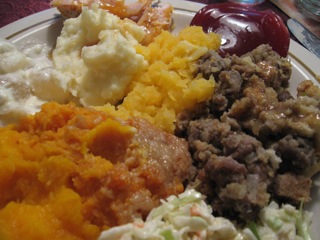
MY MOTHER SAID IT WOULD JUST BE THE FOUR OF US. Usually on Thanksgiving, Leah and I end up at Leah’s parents’ house. Or we end up staying home and Leah makes turkey meatballs and mashes every type of root vegetable she can locate at Wegmans. This year, I wanted to spend Thanksgiving with my parents for the first time in about ten years.

I asked Leah if she was interested in joining me. “Who’s going to be there?” she asked tentatively. Leah did not like holidays, and she did not like people, which meant she only attended events where Vicodin was on the menu. My parents served wine, port and whiskey which she deemed acceptable substitutes.

Creating holiday traditions with Leah is like trying to convince a seven-year-old boy to take a bath. Okay, I have no idea what it is like to convince a kid to bathe. But I do know what it is like to try to talk my girlfriend into doing something festive that she thinks is fundamentally stupid. But with some pushy coaxing, she finally tries whatever activity I want, like carving a pumpkin or decorating a Christmas tree, and in the end she loves it. The next year we start all over again with her grumpy refusal to partake in celebrations without a kick in the ass.

On Thanksgiving day this year, an hour or two into wine-inspired conversation with my parents, the doorbell rang.

“Well, that’s a lot of ice cream for five of us,” my mom said, taking their friend Jim’s grocery bag. On cue, the phone rang. Judy had decided to come early with her husband and two young boys to have dinner at my parents instead of at her in-laws. The turkey was taking too long and the boys were getting hungry. Just the four of us was morphing into just the nine of us. I refilled Leah’s wine glass.

A few minutes later, I was sipping wine in the kitchen with my sister as her kids ran around. “I loved your memoir essays,” she said to me. “Thanks for sending them. I like your creative take on things, especially that rum incident when you were fourteen.”

I asked her what she meant.

“You know, everyone remembers things differently,” she said. “And you were drunk.”

My mom chimed in. “And you get to use creative license and make up stuff, since it’s your memoir.”

I was pleasantly surprised that they supported my “creative take” when it included things they had said and done, but their support also made me uneasy, because, well, I thought the memory was fact when I wrote it. I prodded my sister to share her version of the evening.

Judy recalled that she did not say she was going to tell my parents I was drunk on the night she picked me up at the roller skating rink. She claimed she never told them, that she said to me that night in the car as I threw up into a Styrofoam cup, “I’m not going to tell them, you are.”

I asked my mother how she found out. “Your sister had us paged at the movie theater,” she said. “We came home and she asked us to wait until morning to confront you. She was very protective over you.”

My sister? Protective? “I thought you wanted to see me get in trouble,” I said to Judy. “You were so competitive.”

“I was not competitive,” Judy said.

“Yes, you were,” I said.

“No, YOU were.”

“But you told me how competitive you felt in high school.”

“No, you told me YOU were competitive,” she said. “That’s so funny you remember it that way.”

“You’re kidding, right?” I said. I turned to my mother who was stirring the gravy and asked if she had ungrounded me early because she was worried about my mental health, which was what I had assumed because I was so miserable after I got caught.

She said no, that she and my father did talk to me that night while I was drunk, a conversation I have no recollection of, and in the heat of the moment they grounded me for a month “because that’s the kind of thing you do when you’re mad.” They recognized later that two weeks would be sufficient and reasonable for the offense.

“What about the rum cake?” I asked my mom. Suffering from a tortuous hangover and the dry heaves, I had to serve rum cake at the church rectory the day after my drunken escapade. “Did you call the cook and tell her to make rum cake?”

That, my mother said, was divine intervention.

-Amelia Sauter

paying rent

writing studio

Whether I deserve it or not, there it is.

I JUSTIFY MY NEW STUDIO LIKE THIS:  I dismissed the lawn mower and the driveway plower.  The lawn mower dudes would have charged us even more this summer due to the number of objects they would need to maneuver around, since Leah planted 23 – count ‘em, 23 – fruit trees.  All of which are being snacked upon like gourmet hors d’oeuvres by our resident deer, Piggy Pet (who glares at us and pees when we come outside to yell at her), her sister Fatty and their fawns.  Now I mow the lawn, which is an ass-pain and a half.  It’s an obstacle course, I tell Leah.  But just think of the fruit we’ll have in the years to come, she says, as Piggy Pet munches, glares and pees.

The shop/studio took up half the driveway, so I’m sure shoveling won’t be so bad this winter.  I say that now.  Ask me again in a few months when the mail carrier leaves one of those “I can’t get to your mailbox, bitches” notes.

I also quit going to shiatsu regularly.  We haven’t played much music this summer so I haven’t been hauling around my 30 pound body bag (bass case), hence I have less aches and pains.  Getting enough Vitamin D helps.  Lawn mowing and anticipating shoveling does not help.

So lawn mowing ($50/week), driveway plowing ($30 a pop) and shiatsu ($65 twice a month) is my portion of the “rent” also known as a home equity loan payment towards the new shop.  Downstairs will be Leah’s woodworking and upstairs will be a creative space for both of us.

I think I can justify not taking any freelancing writing on for now, and just working on my Lounge book.  Here’s an excerpt:

People think being a social worker for 13 years should have prepared me for being a bartender.  My theory is that counseling people is about as similar to bartending as being a surgeon is to chopping vegetables.  Some of the tools may be vaguely related, but a serrated kitchen knife is not the same instrument as a scalpel, and with the exception of Hannibal Lecter, a scalpel would not be used to prepare dinner.

I never dreamed of being a bartender.  When I was 14, I decided I wanted spending money to buy a pair of tight Jordache jeans, the ones with the signature squiggle stitched onto the back pocket where I could keep my oversized plastic hair-feathering comb while I was roller skating, so I applied for a job at the Char Pit and for one at the Catholic Church rectory. I spent the next four years stuffing inserts into Sunday bulletins and emptying priests’ ashtrays.  I never heard from the Char Pit.  I assumed this was a message from God that I was not meant to work in the food service industry.

Not that I didn’t learn some useful skills at the rectory.  I became an expert at answering the phone in a sing-song voice, “Our Lady of Mercy Rectory, may I help you?” and when the priest said, “Oh shit, him again?”  I learned to shamelessly lie to the poor wretched soul in need of spiritual counseling on the other end of the line. “I’m sorry, sir, Father Quinn is not available at the moment.  May I take a message?”

Going to an all girls’ Catholic high school that pushed community service fed my belief that I should be selflessly serving others.  When I was 15, Sister Damien, who chose her unfortunate religious name long before The Omen was released, had me stay back after history class so she could ask me if I had ever considered that God might be calling me to join the Sisterhood. “You mean like be a nun?” I asked her in disbelief.  She was convinced I was being called to the ministry.  I was positive God was not talking to me, not like that anyway.  I liked boys too much to even remotely consider the possibility of a life of chastity.  I had been chasing the high of my first kiss and seeking my Prince Charming since I was 12 (Tomboy Princess).  Sixteen Candles was – and embarrassingly still is – my favorite movie of all time.  I continue to faithfully follow the careers of Molly Ringwald, Anthony Michael Hall and John (and Joan) Cusak.  While watching the Breakfast Club, I intensely lusted Molly Ringwald’s boots.  I was positive nuns did not have such worldly desires.

What was more deeply concerning to me was why Sister Damien had approached me out of 100 girls in my class of ’88, because I assumed I was the only one. What was it about me that made her think I would make a good nun? Did I come off as a bland, asexual being who craved short man-hair and practical shoes? I was mortified at the image that I might be projecting to others.  Did Sister Damien think I would develop an apple-shaped body and cankles, the unofficial yet unquestionable archetype of the Sisterhood? I only told my best friend about Sister Damien’s epiphany, and I swore her to secrecy.

I admit I was a bit of a prissy do-gooder.  Amy Two-Shoes, my driver’s ed instructor called me, which was markedly better than the nicknames given by him to the other kids in my car, “Crash,” “Andy-Pants,” and “Dopey.”  Other than the time I told an elderly Nazi-style nun to fuck off  during a fit of PMS-related hall wandering without a pass, I tried to be good.  Fortunately most of the nuns at my high school leaned toward liberal.  After my parents insisted that I attend a Catholic high school, they probably regretted it when I came home and announced how cool it was that Sister Marilyn had chained herself to the fence at the Seneca Army Depot in protest of nuclear warheads, and that I wanted to go to the warring El Salvador like Sister Donna and be a missionary.  I most definitely, however, did not want to become a nun, at least not if it meant giving up boys and never having sex.

When Sister Damien approached me again my junior year about the start of a peer counseling program at our high school, I jumped at the chance to ignore my own emotional issues and help those less fortunate than I.  Though the program never got off the ground, I felt far ahead of my peers at dealing with depressed coeds and chronic masturbating callers when I volunteered for the crisis line at my college.

Like being a receptionist at the church, counseling also inspired me to put on a happy, how-can-I-help-you face.  Later, as a client-centered therapist with a Masters degree in social work, when I wanted to yell “Snap out of it!” to a college student distressed because he got B’s instead of A’s, or, to an 85 lb anorexic sorority girl, “ Would you just freaking eat already,” I instead encouraged them to describe their early childhood relationships with their parents and how those might have instilled an unrealistic sense of perfectionism into their damaged psyches.

Bartenders, on the other hand, can walk away from their customers when things get weird or annoying.  I still offer service with a smile, but if I ask someone, “How are you?” as I greet them with a napkin and a menu and they say, “I just had the worst day of my life,” my response is, “What can I get you to drink?”  Easy fix.  You feel bad, I get you a drink, you feel better. I’ve done my job, and I don’t go home at night worrying that you might kill yourself because I paused too long before responding to your deep, vulnerable over-sharing of emotions with a near-stranger.

-Amelia Sauter