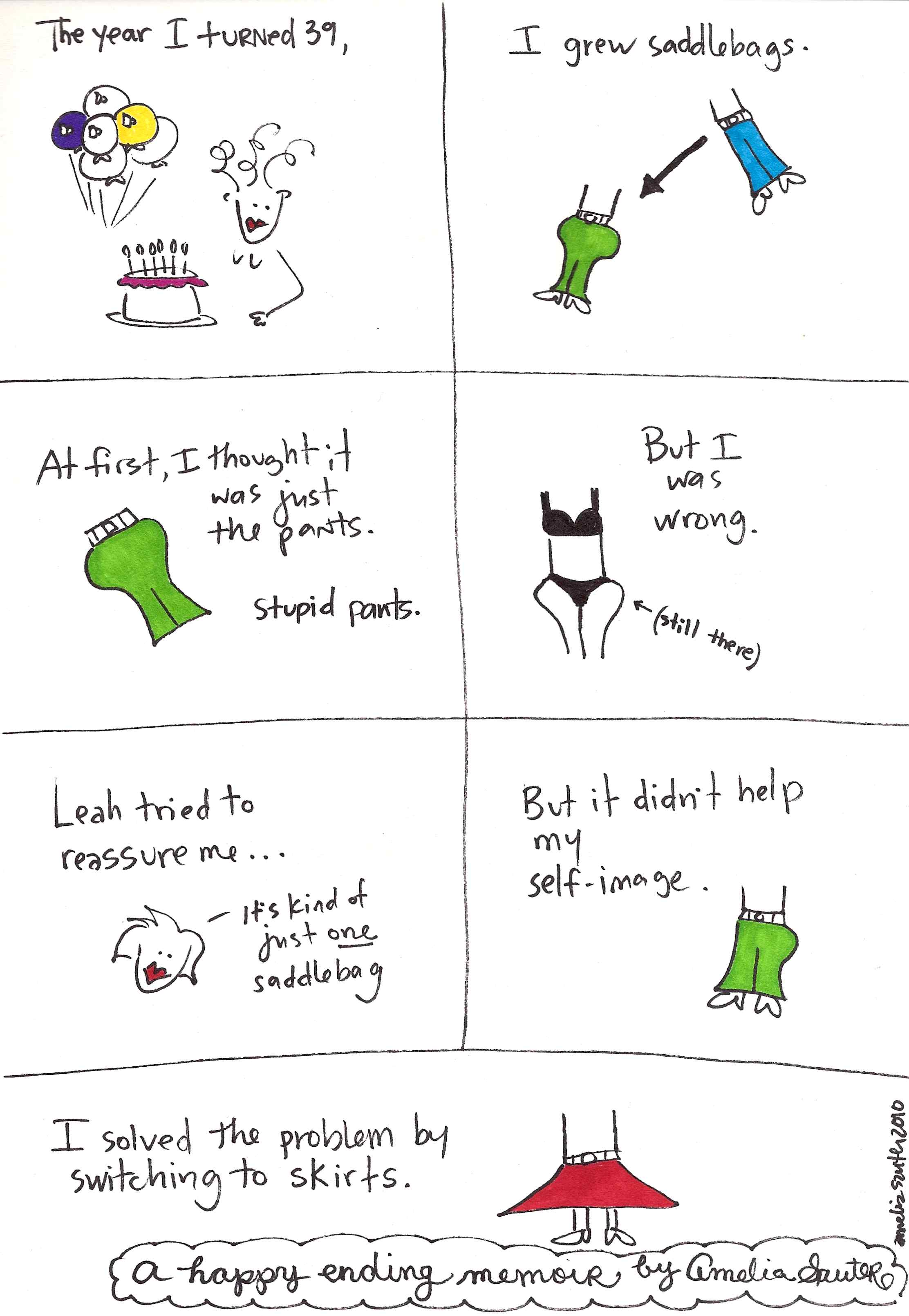
by Amelia Sauter copyright 2010
by Amelia Sauter copyright 2010
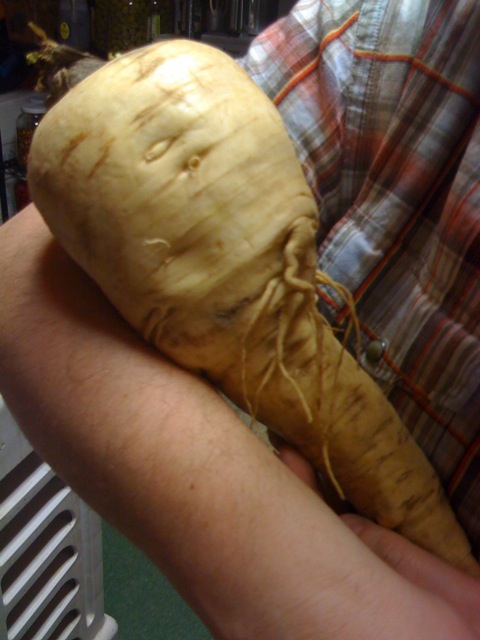
Parsnip, or evil mandrake root baby?
I’M SO RELIEVED MY CSA IS OVER for the season. I’m a huge fan of the “buy local” movement, but the pressure to cook and eat vegetables has become almost unbearable.
For those who aren’t familiar with the concept, CSA stands for community supported agriculture. Regular citizens who love the idea of a garden but who don’t have yard space (or who, like me, kill every living plant thing they touch) can buy a share in a farm for the summer. The farmers grow and harvest the crops, and the CSA members get a pile of fiber-filled vegetables and a Locavore Movement, or L.M.
The problem is, I’m a mood eater, not a seasonal eater. Every week starting in late spring, we took home as much kale as we desired from our CSA, but I’m only in the mood to eat kale once every six years. I only eat beets when my mom cooks them with sugar and vinegar, I reserve my carrot intake for parties when they’re on a raw vegetable platter with French onion dip, and I can’t say I’ve ever craved rutabaga. Call me “locationally insensitive,” but in the middle of summer, my ideal snack is fresh pineapple, mangoes and chocolate.
Celeriac, broccoli raab, tatsoi, and turnips? No, thanks. Salad greens? Pass. Potatoes are a different story. Thank goodness we got plenty of spuds from our CSA because they are my ultimate mood food. Whether mashed, boiled, grilled, or French-fried, potatoes soothe my soul, much like tapioca or macaroni and cheese. But no matter how you dress it up, you can’t take salad out to the Comfort Food Ball.
Presentation affects my appetite, too. Dirty dumpling squashes tossed in bins don’t turn me on. Now if a farmer handed me a plate of butternut-pear raviolis with maple-glazed duck and rosemary sauce, I’d join that CSA in a heartbeat.
The best stuff available at my CSA this summer – green beans, snap peas, cherry tomatoes, raspberries and strawberries – were u-pick. I couldn’t find the time to dilly-dally in the field, can tomatoes or make raspberry jam (see “Do You Have a Ball Jar Addiction?” below). Though I think straw hats and retro aprons are sexy, a 1950s housewife I am not. Hand me the phone and we’ll order a pizza and crack open some PBRs. I actually bribed someone to pick my berries this year, but after she realized how much work it was, I doubt I could get away with that one again.
So we’re left with guilt: guilt for not u-picking, guilt for taking more potatoes than parsnips, guilt for composting the wilted greens hidden in reusable cloth bags in the back of the fridge, guilt for buying flowers at Wegmans rather than picking them on the farm. My CSA makes me feel bad about myself. If I really want a low self-esteem, all I have to do is plant a garden. Neglecting it comes naturally to me, costs less than a farm share, and my meager harvest leaves little leftover for the groundhogs who live in our compost pile.
Next year, I don’t think we’ll join the CSA. We’ll still eat local, but we’ll buy produce we’re in the mood for, as we need it, and when we know we’ll have time to cook it: A little eggplant here, a little corn there, and a little Viva Taqueria burrito and margarita every Friday.
Now go eat your spinach; there are groundhogs starving in Trumansburg.
*Do You Have a Ball Jar Addiction?
1) Do you feel like you always need more Ball jars, no matter how many you already have?
2) Every time you see Ball jars at the supermarket, do you have to buy a case?
3) Are Ball jars impeding the organization of your overflowing cupboards?
4) Has your partner, spouse or housemate suggested that you have a problem with Ball jars?
5) Are Ball jars interfering with your home life?
6) Have you ever gotten into financial difficulties on account of your Ball jars?
7) Does using Ball jars increase your sense of self-worth?
8 ) Do you have Ball jars hidden everywhere, like in your shop, your car, your workplace, your house, under your bed?
9) Do you need to consume something from a Ball jar at every meal?
10) Do you refuse to share your Ball jars with others, even those you love closely, especially the wide-mouth or decorative ones?
11) Have you considered canning strange things, like ground beef, cornbread or green tomato chow-chow?
12) Have you resorted to stealing Ball jars out of the neighbors’ recycling bins?
If you answered “yes” to three or more of these questions, then you have a Ball jar addiction. You need help. And you need to join a CSA.
-Amelia Sauter

I feel empowered.
Click here to enjoy an audio recording of Amelia reading this story aloud.
HAVING SPENT COUNTLESS YEARS SEARCHING for spiritual connection in my life, I feel I’ve earned the right to make fun of the mystical quests of fellow seekers. (Not to their faces, of course; that would be rude.) I’ve tried it all: chanting, fasting, rebirthing, Reiki, runes, magic mushrooms, Bikram yoga, Ashtanga yoga, Kundalini yoga, seventy-three other types of yoga, drumming circles, reading Tarot cards. This last I failed miserably at because I could never remember what all the darn pictures meant, but I’m sure that now, there’s an app for that.
The other day, I overheard a conversation between two women about one of them visiting a psychic. “She told me my totem animal is a red-tailed hawk,” the short, round woman said to her captivated friend, who was nodding supportively. “I already knew it was either that or an eagle. I can feel it in my soul.” She stretched out her arms and flapped twice. “The wings, the flight.” In her long, heavy black coat unbuttoned to expose a white shirt, she looked more like a penguin than a bird of prey. “Mine is a wolf,” her friend said, in what sounded like a “my-power-animal-can-beat-up-your-power-animal” tone of voice.
Why, I wondered, are our totem animals always discovered to be carnivorous predators who can eliminate their helpless prey with one powerful snap of their jaws or beaks? Why not a penguin? Some people could be better matched with less intimidating animals, say a weasel or a mosquito, though I imagine if a soothsayer told me my power animal was a squirrel, I’d feel cheated.
When I was in my early twenties, during a hippie phase that I swore was not a phase, I visited a shaman. I was about to embark on a year-long cross-country trip with no specific destination, and I was desperate to feel brave, or guided, or both. I nervously arrived at the shaman’s suburban home clad in my wraparound batik skirt and oversized Andes sweater that smelled like a wet yak when it rained. The shaman, Carol, looked androgynous, like a bland middle-age woman who drove a minivan and attended Rotary meetings, but I heard she took Level One Shamanism with Michael Harner, the author of The Way of The Shaman, so that meant she was legit, right? Carol seemed awkward and surprised to have someone in her house, as though she hadn’t advertised that she would enter shamanic trances in the company of strangers for the right amount of money, which in May of 1994 was $45.
She told me to lie down on her living room floor and explained that she would bang rhythmically on her Native American drum for about an hour while she entered a trance and met my power animal. Somewhat skeptical of the whole thing, and weirded out about laying on her floor, I asked her if sometimes animals didn’t show up. She looked offended, and said not to worry.
She must have been good, or my animal must have been ultra-eager, because after fifteen minutes of drumming, she suddenly stopped.
“A red-tailed hawk,” Carol reported. That sounded okay to me, but I felt no link to this particular creature, or to any creature, really. Carol instructed me to find a representation of my power animal to carry with me at all times, like a picture or an amulet. And she said to go outside and meditate on the hawk that day for at least twenty minutes, and my connection would become clear.
That afternoon I went for a walk in the Six Mile Creek Wildflower Preserve to contemplate my new totem animal and insure my $45 was well-spent. The Wildflower Preserve and neighboring water reservoir had been recently voted “Ithaca’s Best Kept Secret,” and it was also Ithaca’s favorite exhibitionist hang out. I had skinny-dipped in its waters with friends on many occasions, but this was my first time walking there alone.
Since the day had warmed up, I left my yak sweater in my truck. Sunlight showered the forest, catching flecks of green buds and flitting birds. I pondered my red-tailed hawk spirit guide and tried hard to feel it accompanying me. I didn’t encounter any other people on the path, until I saw a young man jogging towards me from the direction of the second dam. He was about twenty years old, with curly dark hair and matching pop-out eyebrows, a short red tank top, and running sneakers.
And no pants. As he ran towards me, his meat and potatoes bounced side-to-side with each stride. He passed within a foot of me, and he stared me straight in the eye as his manitalia dangled in the sunlight.
I had a healthy fear of the woods, of bears, vampires and the other monsters that might inhabit them, but I was not prepared for this pantless exhibitionist on the path. Somehow he felt different than the innocent nude sunbathers my friends and I had encountered at the reservoir previously. Both his nakedness and his stare felt designed to intimidate, possibly even threaten. I sensed he would be back, and I felt panic rising in my chest.
I could run – but to where? Deeper into the woods? The man had disappeared in the direction of my car. I wished desperately for the ability to fly, that a belief in the red-tailed hawk would aid me in a time of need.
So I did what any strong, scared woman might do in my situation. I hid. A large boulder sat about twenty feet from the trail, and I ducked behind it, just as I heard Mr. Sausage-and-Eggs’ running footsteps make a second approach.
I tried to slow my breathing, but that’s hard to do when you are not convinced that you are safe. My heart was pounding so loud that I was positive he’d hear it and find me cowering there. Would he be smart enough to guess my next move? Was he a hunter of women, a master at his craft, or just a dumb guy running around with no pants on for kicks?
He ran by again, and then I heard his footsteps fade. I don’t know how long I sat there, my back pressed against the rock and my batik skirt growing damp where my butt met the cold, spring forest floor. As I calmed slightly, I noticed a feather on the ground directly in front of me. It was about twelve inches long, with brown and white stripes. A red-tailed hawk feather! My totem animal was guiding me! The feather was the sign I was waiting for. My spirit guide had protected me, and would continue to do so on my travels. It was true after all.
When the man didn’t return a third time, I realized that at some point I’d have to leave my hiding place. So I finally jumped up, clutching my prized feather, and sprinted to my car, where I scrambled in, then slammed and locked the door.
I drove straight to a girlfriend’s house, collapsed on her couch and shared my story of the shaman, the woods, the man with no pants, my fear. I twirled the feather between my index finger and thumb as I told her how the red-tailed hawk must have guided me to the boulder.
“I guess it wasn’t a coincidence,” I said.
Then my friend’s housemate walked in, a guy I didn’t know much about other than that he worked at Cornell’s Lab of Ornithology.
“Oh, hey,” he said. “Where’d you find the nice turkey feather?”
A turkey. My friend laughed.
“Turkey?” I said. “Are you sure?”
He took the feather from me and described how he knew it was from a turkey. Science conquered coincidence, and my skepticism flooded back, this time for good. I felt silly, but also relieved to be spared further embarrassment.
That was the last time I spoke aloud about my power animal. My wistful quest for connection, however, continued for another few years, culminating when I finally met my one true love. Around the same time, I also discovered martinis. Finally, I was satiated.
This week on Facebook, I saw a lot of people posting their spirit animals (most of them were otters, which I’m not convinced is any better than a being turkey.) This is the new generation of seekers. They don’t have to spend money or endure a trial with a half-naked man to make fools of themselves. Now, there’s an app for that.
-Amelia Sauter
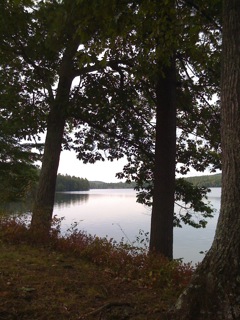
Shhh - do you hear that? That's right. Nothing.
WHEN I GO ON VACATION, my primary goal is not to go far away, it’s just to not be home, where work constantly oozes into my psyche. All I want is to escape the stresses of daily life that seem to multiply like the fruit flies in my kitchen compost.
The night before we left for a trip to Maine last month, my 18-year-old cat attempted to thwart our vacation plans by staging a dramatic panic attack as we clipped her nails, in classic Sanford and Sons “This is the big one!” style. In a state of utter terror, she sprang from my arms, staggered in a wobbly circle like a drunk person, then flattened herself to the floor, panting and limp, where she remained for an hour until she smelled chicken cooking. Typically the cat’s only activities are sleeping, eating, avoiding cleaning herself, and wandering outside for five minutes a day to eat grass so she has something good to throw up later. Her constant snoring sounds remarkably similar to a death rattle, but the little bugger always wakes up.
She’s one of the many good reasons to leave town.
Leah and I like to rent places on the water, whether a lake or the ocean. Because we don’t plan to get off our asses for a week, it’s nice to have something attractive to gaze upon besides each other and my screensaver, which is a vacation photo of Leah sitting by a lake. We discovered the joy of cushy accommodations when Leah once joined me at a social work conference at an all-inclusive resort on the ocean. They cleaned for us, served us our meals and left a treat on the dog’s pillow every night. We were hooked.
Now our only requirements for vacationing are that a place allows dogs, bans smoking, offers privacy, and is rentable after Labor Day so we don’t have to suffer the sounds of squealing children. The little thoughtful touches added by the landlord make us happy: Wine glasses. Curtains on the windows. Ice cube trays.
I’ll spend a half hour paddling in a cottage’s kayak, because it’s there and I feel the need to say I used it. We’ll take a daily walk because the dog makes us. But when we arrive at a cottage, the first task we do is check the freezer and make ice cubes. If there’s one thing I learned from my parents, it’s that vacation is the time to drink. [Edit from Mom: What do you mean that’s the one thing you learned from your parents!? How about: Take enough clean underwear and a shopping bag full of books.]
Bourbon, beer, wine, gin and Grey Goose Orange are on my packing list alongside shampoo and novels. Since opening the Lounge six years ago, alcohol has come to symbolize success and relaxation. It’s how we make our living, how we find inspiration, and how we wind down at night, even while on vacation. Especially while on vacation. Leah’s latest creation is a cardamom syrup with lime, gloriously combined with gin – an escape in a glass.
On the bay in Maine, we met our neighbors Neil and Pam, who were renting the larger cottage next to our tiny one. Things started to feel homey. I borrowed a pan from them to bake apple crisp. Pam and I chatted about yoga. Neil greeted me on the dock the next day as I returned from my perfunctory paddle. “How do you get out of the kayak without tipping over?” he asked, a surprising question from a man who sailed a 29 foot sailboat and seemed to know random facts about everything.
“See that island over there?” Neil pointed to a wooded island in Quahog Bay with a fancy house and a bunch of moored yachts. “Dodge Morgan has owned that island for 30 years.”
Dodge. What a great name. Get out of Dodge, that’s what we were trying to do. Dodge our lives.
“He’s a famous world-class sailor who has sailed around the world,” said Neil. I wondered silently what it would be like to live somewhere amazing like that year-round. Would it still feel like vacation, or would the pressures of daily life hunt me down and stalk me at an oceanfront cottage? Would an island escape soon turn into home as I found myself borrowing a pan from the neighbors, and clipping the drama cat’s nails? Was Dodge Morgan rich, retired, stress-free? Would I win the lottery someday so I could be the same?
“He died this week,” Neil said.
That night, colorful fireworks burst over the island. As the wind died down and the moon rose, we could hear the voices and laughter of those celebrating the life of Dodge. Leah and I sat outside on the deck and watched the display, slapping at mosquitoes that shimmied on our faces. The fireworks scared the dog, but at least his panic didn’t involve a faux heart attack like the cat’s. Over a Grey Goose Orange and tonic, we pondered how short life is.
“We can’t take it home,” Leah said. “Ever.” She was talking about the vacation feeling that we desperately wished would continue after we returned to Trumansburg. “But we can enjoy every second of being away.”
Maybe vacation isn’t about being somewhere else after all, I thought. Maybe it’s about being exactly where you are at any given moment without being filled with the desire to be elsewhere. Vacation, from the latin, vacare. To be empty.
As the fireworks faded, I thanked my lucky stars that I’m not Dodge Morgan, even if he had a cool name. I’ve got a lot of years left to live, and apparently so does my cat. Time to make the most of things.
-Amelia Sauter
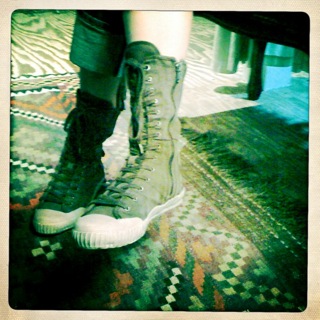
I thought 'barefoot clean" referred to bare feet. Boy, was I wrong.
WHEN MY PARTNER LEAH AND I FIRST OPENED OUR OWN BUSINESS, we didn’t have time to eat or bathe regularly, let alone clean our house. After three months of my groveling about how much more fulfilling my life would be if someone mopped the floors weekly, Leah finally succumbed to my begging and said we could hire a house cleaner, though she made it clear she wasn’t thrilled with the idea.
We knew only one or two people who used house cleaners. One finicky gay couple told us they paid a little old lady to clean their house, but they said she did a terrible job. They described at length how they only used her because they used to employ her daughter, who was meticulous, but who moved away and handed the job over to her not-so-tidy mother. Then the mother cared for their dog when it was dying, and they felt indebted to her because it pooped on the rug with clock-setting regularity, and ultimately they didn’t have the heart to fire her.
I turned to craigslist. Under “household services,” there was a grand list of employment-seeking cleaners from which to choose. One post was titled “Barefoot Clean.”
I liked the sound of that. Even my do-it-yourself mother would approve. When I was growing up, she washed all the dishes before putting them in the dishwasher, rendering it impossible to tell when it was time to empty the machine. On a weekly basis, she religiously changed the sheets, laundered the towels, scrubbed the bathrooms, vacuumed, dusted, and mopped. Her house was barefoot clean; you could eat off the floor even if a bite of dropped food loitered there more than five seconds. When I walked around my own house barefoot, I ended up with dog fur, cat litter and pretzel crumbs on the bottoms of my feet. I wore slippers constantly to prevent a dirt-triggered anxiety attack.
But while I inherited my mother’s preoccupation with cleanliness, I did not inherit her work ethic. I set up an appointment for “Rob” to come to our house.
The next day, a smiling 50-something-year-old man, sporting khaki shorts, a sparkling white t-shirt and a potbelly, sauntered up the walk in bare feet.
“He’s not wearing any shoes,” I whispered to Leah, who was working at her computer at the kitchen table. That explained the “Barefoot Clean.”
I invited Rob inside, thinking how it was rather convenient that I didn’t have to ask him to remove his shoes. “You’re barefoot,” I said. I was a former social worker trained to name the elephant in the room as soon as it reared its mighty trunk.
“Yes,” Rob replied with a big grin. “As often as possible.”
We showed him the house, which took under 60 seconds since our one-story bungalow was only about 700 square feet. Perfect for the two of us, small for the six-member family who lived there for the twenty years preceding us.
Rob and I stood back at the door after the mini-tour. Leah returned to her seat at the kitchen table, but I knew she was following every word.
“Do you have references?” I asked.
Though not as suspicious as Leah, the idea of a stranger poking around my belongings made me uneasy. While I was pleased to own a copy of Playboy’s Girls of Home Depot edition, I didn’t want anyone else perusing my nothing-but-an-orange-apron vixens. I also loved looking in people’s medicine cabinets when I was visiting their houses, but that didn’t mean I wanted someone exploring mine. (I’m guessing I’d get fewer invitations to parties if people knew my habit.)
“Well…” Rob hesitated and glanced up at the ceiling, over at the walls and down to his bare feet. Then he stared me straight in the eye. “Only from my nude modeling job,” he said. He waited for my reaction.
“I guess that’s fine,” I said.
I tried to keep his gaze, like a good non-judgmental therapist whose client had just blurted an awkward confession. I’d nude modeled for artists in my younger, experimental hippie days. To break the tension, I joked, “As long as you don’t plan to clean our house nude.”
Rob frowned. “Oh, would that be a problem?”
Suddenly I got that Barefoot Clean actually meant Bare Ass Totally Naked Clean. “Um, yeah, um, I think, um, it would,” I said. I could feel Leah trying not to laugh behind me. I too struggled to maintain my composure.
“You said in your email that you preferred your house cleaned while you were at work,” Rob said, “so why does it matter if I’m nude?”
I imagined a naked man vacuuming my rugs while his man-parts enjoyed their lack of restraints. Then I considered how when one reaches up to clean the top of the tall mirror in the bathroom, one’s pelvis presses against the counter. “I think it would make me uncomfortable,” I said.
“Oh, okay, well…” Rob said. His eyebrows furrowed crookedly, which made one half of his face look disappointed, and the other half appear irritated that I had just wasted his time.
“Um…” I said.
“I’d better be going,” he said.
“I’ll, um, be in touch or something,” I said.
Leah and I immediately googled “nude house cleaning” after Rob left, which presented us with 290,000 search results. Some people even advertised that if allowed to be naked, they would clean your house for free. I contemplated whether Rob’s services would be more appealing if we didn’t have to pay him. I wanted a clean house that badly.
I called my mother to ask her opinion. “You’d have to check for ass prints on your kitchen chairs,” she said. “And I don’t want to imagine where he’d carry your house key.”
That night, we cleaned the place ourselves, top to bottom. For free. And while it wasn’t Bare Ass Totally Naked Clean, it was as close to “barefoot clean” as we’d ever get.
-Amelia Sauter
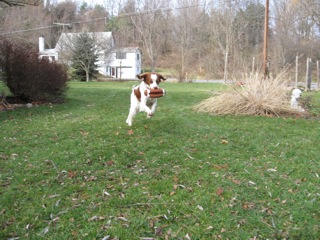
I wouldn't run if you threw a ball for me to fetch.
WHEN WE WERE ELEVEN YEARS OLD, my best friend Melissa and I decided we should jog. It was the 80s, and everybody was doing it. I even owned a little yellow-and-white terry cloth jogging suit. Our “jog” consisted of a ¾ mile walk-trot up the road to the shopping plaza, where we landed either at a) the donut store; b) Burger King; or c) Carvel Ice Cream.
Thirty years later, my style of exercise hasn’t changed
much. I’m trying to get used to the idea that I should exercise to lower my cholesterol or to prevent cancer or because I’m 40, but I still require a reward-based motivation of some sort to move my legs faster than a lollygag.
Food remains a primary motivator for me to get off my butt, though what I consume after my workout has taken on a more grownup tone. Instead of If I jog to the plaza, I can have an ice cream, it’s now more like If I spend an hour on the treadmill of torture, I deserve a gin and tonic.
Take for example my summer hikes with my girlfriend in the National Forest: proximity to food and drink is the key. All of our hikes revolve around an accompanying sandwich and hazelnut coffee at the Grist Mill Café in Burdett. Which means we don’t walk on Sundays and Mondays when the Grist Mill is closed, nor do we walk after 3 p.m. Sometimes when we eat there, we don’t make it into the forest at all.
Though the gym is so close to my house that I can hear it laughing at me, working out eludes me, perhaps because the gym has no adjoining restaurant. However, it tempts me with television. My reward for running is an hour with the Real Housewives of New Jersey or Stephen Colbert. I’m also fostering a meaningful connection with FitTV’s Bollywood Workout babe.
If I’m going to be walking somewhere unusual, far from TV or a place to eat, like on railroad tracks or along a desolate dry creek bed, then I identify off-color reasons to keep me interested in moving. Like maybe I’ll find a dead body, which I’ve wanted to do ever since I watched Stand By Me.
My most surprising adulthood exercise initiator is a dog. As a kid, I wasn’t allowed to have any indoor pets. (Now that I’m the one cleaning the house, I understand why.) I got my first dog when I was in my early 30s, and that’s when I found out that a dog gets my ass out of the armchair where I can otherwise sit for days on end with my laptop computer.
When I ask my dog, Eesah, if he wants to go for a walk, he does a hoppy little dance like he just won the lottery. How can I resist? A walk around the block – past the same houses he’s walked by hundreds of times before, and the same lilies he always prefers to pee on, and the same squirrels he pauses to point at – is the most rewarding experience in the world to him. This exuberance is matched only by his reaction to occasional car rides and his regular daily meals, the same Purina One chicken chunks he’s eaten for the previous nine years.
Eesah eats, walks, pees, runs, sticks his head out the car window, and he’s happy. He doesn’t think to himself, I should walk today so I don’t get osteoporosis, or Let’s see, I ran six miles. That means I burned 176 calories, so I can eat all of my dog food without guilt tonight. Wait a minute, how many calories are in these chicken chunks?”
If only I were so easily pleased, and so easily motivated. The dog does not require an additional treat at the end of his efforts. The walk itself is reward enough.
-Amelia Sauter

Who cut the cheese?
I LOVE THE CONCEPT OF ENSURING our planet’s future via reusable shopping bags. But damned if I can remember to bring them into the store with me.
Many of us suffer from a mental health problem known as bag amnesia, or bagnesia, a disorder whereby the repetitive forgetting of reusable bags induces stress and impedes the eco-conscious procurement of guilt-free groceries. For some, bagnesia strikes sporadically; for others, weekly. I often forget my reusable bags at home, or even more frustrating, I get to the checkout at the grocery store and realize that I’ve left them in the car, a half mile away at the far end of the Wegmans parking lot. Some days, I can’t find one anywhere, at home or in my vehicle. Particularly strange, since over time I’ve managed to accumulate about twenty-three of them.
Seven years ago, I bought my first cloth shopping bag from a cheese shop in Montreal. The bag was a thick, durable-yet-soft canvas with a colorful cartoon drawing of a cow, sheep and goat on the side. The caption read, “Que lait cru!?!”, the name of the fromagerie. Since I don’t speak French, I have no idea what this phrase translates to in English, so I just tell people it means, “Who cut the cheese?”
When Wegmans started offering reusable black grocery bags, I bought two. The following week, due to a bout of bagnesia, I left them in the car. When I went into the store, I bought two more at the checkout counter. The next week, more bagnesia, and two more bags. Eventually, I had at least twelve reusable bags from Wegmans, none fulfilling its purpose, and only one of which I could locate at any given time. After that, when bagnesia struck and I was faced with the question, “Paper or plastic?” I guiltily accepted plastic bags, promising the totally uninterested, bored teenager at the cash register that I would repurpose them for picking up dog poop.
Reusable bags have recently become popular souvenirs, conference treats and marketing tools, like the Sysco Foods canvas satchel that I used as a purse until the strap broke. The message in giving away or selling reusable bags? “We are a company of people who care, and if you know that, maybe you will buy more stuff from us, or at least you’ll think we’re cool.” And some of the companies are cool. I have an Erma Bombeck Writers Conference bag, an Ithaca Festival (“I am Ithaca”) bag and two Ithaca Farmers Market bags, plus two Greenstar bags and two giardia-hued fluorescent green ones from Sweetland Farm where I pick up my weekly csa. And after I dropped more than a few hints last Christmas, I found NPR’s coveted Nina Totin’ Bag under the tree. Every time I use one of these sacks instead of a plastic bag, I personally save the life of a sea turtle named Ned.
My most recent acquisition is a birthday gift from a friend. This one is the smartest: it’s dark blue canvas. Most cloth bags are a bourgeois tan, in the same class as khaki pants or an “I’ll-just-buy-another-if-I-stain-it” white polo shirt. I prefer the canvas to the plasticky woven bags. Sure, you can recycle the plastic ones if they tear, but the beat up canvas ones can be reborn into a new afterlife if they are cut into hankies or diapers. (I’m speaking theoretically, of course. I break out the sewing machine about as frequently as I get my tetanus booster, and I have no plans to ever need diapers in my house.)
A recent search of my home and car turned up five of my twenty-three reusable bags: Nina, Who Cut The Cheese, I am Ithaca, one Greenstar and one Wegmans. Which is more than enough to go shopping, if only I remembered to bring them.
-Amelia Sauter

It's not that bad. Okay, maybe it is.
AS AN ON-AGAIN-OFF-AGAIN SUFFERER of debilitating migraines, I’ve learned to focus on the positive side of being ill, if only to prevent me from offing myself, which has obviously worked so far.
Take blind spots as an example. Prior to the onset of a migraine, I lose some of my vision. While it can be dangerous if it hits me while I’m driving home from Syracuse at seventy miles an hour on Route 81 (which it has), my partial blindness is blissfully pain-free compared to the agony I’ll endure in about an hour, and it alerts me to prepare for my impending episode of prolonged uselessness. If I’m at home during this invaluable time, I blindly wash my face, brush my teeth, drink some water, eat a snack, pull down the shades, cancel appointments, and brief Leah on whether or not I picked up the dog poop that morning or if there are wet clothes in the washer.
And then, as quickly as I lose my vision, it comes back, and with it, pain. Migraines are both physically overwhelming and emotionally devastating. Light hurts my eyes, the tiniest sounds rattle in my ears like snare drums, and it feels like my forehead is about to give birth to an angry, out-of-control alien creature who is pounding on my skull from the inside. Where’s Sigourney Weaver when I need her?
The bright side? In my sea of pain I enter a semi-conscious state for twelve to twenty-four hours. When I feel a migraine starting, I kiss my partner Leah good-bye as I slip far, far away.
It’s strangely peaceful in a cocoon of pain. The world stops. I couldn’t function if I tried, so I give in. I lose days sometimes. During the few minutes I regain consciousness here and there, my eyes don’t work well enough to read, my speech is slurred and I can’t complete sentences.
When else do we get to shirk our responsibilities without getting in trouble, except when we are sick? Forget about emails, phone calls, Facebook, dirty dishes. Sick people are allowed to be cranky and selfish. We might even get some sympathy.
Being sick is almost Zen. When we are ill, we live fully in the moment, unable to escape our aches and pains by distracting ourselves with either work or pleasures.
Unless we’ve scored some good drugs. So far I have not found a migraine medicine that stops the pain, but I carry a precious prescription of anti-nausea pills in my purse, pleased to have my drugs stealthily stashed on me at all times, as if it’s the Prohibition Era and I’m carrying a flask of top-notch hooch. As far as I know, Promethazine has no value on the black market, but I don’t care, because I would never part with even one little pill. I’m so relieved that I don’t vomit during my migraines anymore that I want to cheer.
Catch me on a bad day, and I’ll tell you my migraines are a curse. Today, though, when I’m not in pain, I count my lucky stars. I focus on how migraines have made me eat better and exercise regularly and drink more water. At least I haven’t landed in the E.R. or lost control of my bowels. Yet.
During a recent out-of-town trip to visit family, I realized I was getting a migraine when I gazed across my hotel room, caught sight of the welcome folder on the dresser, and read its title:
Supe 8.
I couldn’t see the “r.” I looked over at Leah, who was sitting on the bed next to me, and she only sported one eye. No, I was not asleep and dreaming of a Picasso-like painting of my lover. I had a blind spot, and I knew what would come next:
I got out of coffee with the in-laws.
-Amelia Sauter

You want me to get on an airplane? Drugs, please.
ANXIETY RUNS IN MY FAMILY. So do large foreheads and potbellies, but those don’t prevent me from getting on an airplane. I’d avoided flying the anxiety-filled skies for the last ten years, but now I would feel like a wimp if I told my best friend– who was 600 miles away, alone with a newborn, and in need of my assistance–“hey, I got the weekend off and found a really cheap plane ticket, but I’m too scared to fly, so sorry, you’re on your own.”
I would do it. I would go. But to board a plane, I would require drugs.
When I was a psychotherapist, I discouraged clients from relying on psychiatric medications. Meds are Band-Aids, I would say. They don’t fix the problem; they mask it. You should only use meds if your life is at risk. Like when you are getting on a plane.
My mom – who hates to fly – said her neighbor Sally attended one of those get-rid-of-your-flying-phobia classes that involved facts, relaxation techniques, a tour of the airport, and at the end, a fear-free flight. “Are you kidding?” I asked my mom. “Why would I want to convince myself that I’m not going to die?” That would be tricking myself into a false sense of security while speeding through the clouds at forty thousand feet in a flying tube of death. I did not want my last thoughts in this world to be, “Feet relax. Feet you are relaxing. Feet you are relaxed.” No, I would put my affairs in order, say my final goodbye to my partner Leah, and take my Xanax.
The day of my flight, I posted my last will and testament on Facebook and hugged Leah tightly at the security checkpoint, assuming I was about to plunge to my death in the ocean because the plane’s engines will fail due to some human error, like a mechanic confusing a bottle of personal lubricant with WD-40 – “oops.”
Boarding the rickety commuter plane was as easy as ripping out my own heart with a pair of pliers, but at the last minute, I surprised myself by forgoing the Xanax so I could take Promethazine, a travel sickness pill. This would prevent me from throwing up on the woman sitting beside me, who kindly offered me the window seat and then leaned as far as she could into the aisle to distance herself from my growing pile of grieving Kleenex filled with tears and snot. I tightened the lap belt over my potbelly and prepared to face my death without the assistance of a mind-numbing psych med. Maybe it’s not such a bad thing to face my mortality and have my affairs in order, I thought. I tried unsuccessfully to convince myself of this as the plane bumped along the runway gaining speed.
I survived the two-hour flight, this time. No plane crash, no death by panic attack. And due to my thoughtful drug choice, the other passengers would remember me as the anxious woman with the big forehead who cried hysterically, which is better than being known as the woman who puked on the plane. Did I mention travel sickness also runs in my family?
-Amelia Sauter
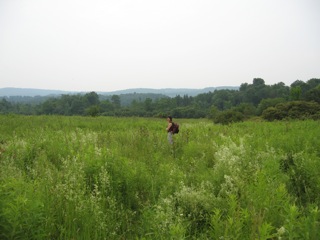
I wish my yard could look like this.
THE EARLY HOT WEATHER this spring gave our grass a head start on its annual quest to reach the sky, prompting me to think that whoever invented lawns should be punished by mowing mine.
I’m the one who usually gets stuck with the mowing, not because I’m better at it, but because I’m not as good at everything else. Because my partner Leah wields power tools, she can repair plumbing, hook up a stove, and build shelves. The last power tool I used was the blender, for frozen margaritas.
Since we moved onto our half-acre plot eight years ago, Leah and I have both avoided mowing our vast yard. I protest; I wait two weeks. The grass gets so high that it takes two hours to cut, and to clean up, I need farm machinery to roll the clippings into oversized Shredded Wheat bales.
We thought of overgrowing our yard into a weedy wildflower delight, but the woman down the street already tried that trick. A nosy old neighbor reported her to the village, claiming her self-made field caused a radical increase in savage snakes and swarming mosquitoes at his house. This is the same vigilante who shoots young deer in his backyard with a BB gun and swears he’ll keep Trumansburg civilized.
Initially, I planted substantial flowerbeds in the hopes of cutting back on lawn time. Now when I mow I get to admire gigantic weeds choking scraggly blooms as I push by. For years, my sister planted only plastic flowers around her house. I’m starting to see the wisdom in sticking inanimate objects that require no maintenance into the dirt to look healthy and colorful year-round.
Grazing might be an option in another town, or another era. Woodrow Wilson used sheep to manicure the White House grounds during World War I. To no avail, we’ve been begging the village to allow us to have chickens, so I can only imagine what they would say about sheep or goats. I’m sure our nosy neighbor would have input.
One year, Leah planted literally twenty-three baby fruit trees in an effort to shrink the lawn, not considering it would be years before they cast enough shade to minimize grass growth. Complete with cages and stakes, the twenty-three saplings transformed our big lawn into a big obstacle course that twists and turns around the snickering trees. Because mowing our yard resembles a physical challenge on a Japanese game show, quotes for hiring someone to trim the grass start at $50 a pop. Twenty weeks of lawn mowing will cost us $1000 for the season. That could buy two plane tickets to Florida this winter when the offending grass is long forgotten under the snow.
In a desperate move to make lawn care meaningful, the eco-conscious Leah purchased a push mower, the kind powered solely by human idealism. Like everything utopic in theory, it’s not very functional in reality. It takes two of us to push it, probably because we let the grass get too long, and it seems to cut only every other blade of grass. Leah faithfully sharpens the push mower’s blades once a year, but that’s all the action it sees. Keep your eye on the “for sale” section of craigslist for this one.
I am jealous of well-manicured lawns dotted with intentional, tidy flowerbeds, clearly cared for by someone with either obsessive compulsive disorder or enough money to hire help. Proud owners of such works of art can join garden clubs. I’d like to start a “I’m Lucky If I Mow My Lawn Once a Month” club so I can have something to feel proud of, too.
Yesterday when I cut the grass, I enjoyed the vindication of plowing right over three dead little fruit trees. Three less obstacles to maneuver around. I took such glee in their demise that I felt guilty.
But that’s what it’s come to: I curse the lawn, I curse the unkempt beds, and I curse the trees that laugh at me as I circle around them again and again. My only reward is that mowing the lawn is a good excuse to drink a beer in the middle of the day.
-Amelia Sauter
Amelia wants to know: How do you cope with mowing your lawn? Send your comments below.
 Drink My Words